

The Best Rolex Watches in 2026: 10 Models Collectors Ask for by Name
Updated: October 2026.
In 2003, Rolex gave the Submariner a green bezel for its 50th anniversary, and collectors named the watch after Kermit the Frog. Rolex has never used that name, or Pepsi, Hulk, Sprite, or Starbucks. Collectors coin them, and a watch only earns one once enough people know it by its looks rather than its reference number.
That makes the nicknames a fair shortlist of the most popular Rolex watches. The ten here include a Deepsea that marks James Cameron's 2012 dive to the bottom of the Mariana Trench and a gold Daytona named after John Mayer. Four of these references are no longer made, and for those, pre-owned is the only way in.
At a Glance
The best Rolex watches are the Submariner, Datejust, GMT-Master II, and Daytona. Pre-owned, the ten below run from about US$ 13,000 to more than US$ 75,000. The steel divers and GMTs sit between about US$ 13,000 and US$ 26,000, while the steel Daytona and the three gold watches all start above US$ 30,000.
- Our pick, and the third green Submariner – Rolex Submariner Date "Starbucks"
- The 1945 size with a tennis nickname – Rolex Datejust 36 "Wimbledon"
- The GMT with its crown on the left – Rolex GMT-Master II "Sprite"
- Red and blue, discontinued in 2026 – Rolex GMT-Master II "Pepsi"
- The gold Daytona with a musician's name – Rolex Cosmograph Daytona "John Mayer"
Browse by collection: Submariner, GMT-Master II, Datejust, Daytona, Day-Date, Oyster Perpetual, Sea-Dweller, Yacht-Master. For prices across every collection, see our Rolex price guide; for every Daytona reference, the Rolex Daytona price guide.
Full comparison
Model Case Movement Price Year Rolex Sea-Dweller Deepsea "D-Blue" 44 mm × 17.7 mm, Oystersteel with titanium caseback Cal. 3135, automatic, 48 h US$ 13,100 2014–2018 (discontinued) Rolex Submariner Date "Starbucks" 41 mm, Oystersteel Cal. 3235, automatic, 70 h US$ 14,000 2020–present Rolex Datejust 36 "Wimbledon" 36 mm, Oystersteel with 18k white gold fluted bezel Cal. 3235, automatic, 70 h US$ 14,700 c. 2021–present Rolex GMT-Master II "Sprite" 40 mm, Oystersteel Cal. 3285, automatic, GMT, 70 h US$ 16,500 2022–present Rolex Oyster Perpetual 36 Turquoise 36 mm × 11.6 mm, Oystersteel Cal. 3230, automatic, 70 h US$ 17,300 2020–present Rolex GMT-Master II "Pepsi" 40 mm, Oystersteel Cal. 3285, automatic, GMT, 70 h US$ 25,600 2021–2026 (discontinued) Rolex Cosmograph Daytona "Panda" 116500LN 40 mm × 12.2 mm, Oystersteel Cal. 4130, automatic chronograph, 72 h US$ 33,900 2016–2023 (discontinued) Rolex Yacht-Master 40 Everose Oysterflex 40 mm, 18k Everose gold Cal. 3235, automatic, 70 h US$ 34,700 2019–present Rolex Day-Date 40 "Olive" 40 mm × 12 mm, 18k Everose gold Cal. 3255, automatic, day-date, 70 h US$ 64,400 2016–present Rolex Cosmograph Daytona "John Mayer" 40 mm × 12.2 mm, 18k yellow gold Cal. 4130, automatic chronograph, 72 h US$ 76,200 2016–2023 (discontinued)
The best Rolex watches are the Submariner, Datejust, GMT-Master II, and Daytona. Pre-owned, the ten below run from about US$ 13,000 to more than US$ 75,000. The steel divers and GMTs sit between about US$ 13,000 and US$ 26,000, while the steel Daytona and the three gold watches all start above US$ 30,000.
- Our pick, and the third green Submariner – Rolex Submariner Date "Starbucks"
- The 1945 size with a tennis nickname – Rolex Datejust 36 "Wimbledon"
- The GMT with its crown on the left – Rolex GMT-Master II "Sprite"
- Red and blue, discontinued in 2026 – Rolex GMT-Master II "Pepsi"
- The gold Daytona with a musician's name – Rolex Cosmograph Daytona "John Mayer"
Browse by collection: Submariner, GMT-Master II, Datejust, Daytona, Day-Date, Oyster Perpetual, Sea-Dweller, Yacht-Master. For prices across every collection, see our Rolex price guide; for every Daytona reference, the Rolex Daytona price guide.
Full comparison
| Model | Case | Movement | Price | Year |
|---|---|---|---|---|
| Rolex Sea-Dweller Deepsea "D-Blue" | 44 mm × 17.7 mm, Oystersteel with titanium caseback | Cal. 3135, automatic, 48 h | US$ 13,100 | 2014–2018 (discontinued) |
| Rolex Submariner Date "Starbucks" | 41 mm, Oystersteel | Cal. 3235, automatic, 70 h | US$ 14,000 | 2020–present |
| Rolex Datejust 36 "Wimbledon" | 36 mm, Oystersteel with 18k white gold fluted bezel | Cal. 3235, automatic, 70 h | US$ 14,700 | c. 2021–present |
| Rolex GMT-Master II "Sprite" | 40 mm, Oystersteel | Cal. 3285, automatic, GMT, 70 h | US$ 16,500 | 2022–present |
| Rolex Oyster Perpetual 36 Turquoise | 36 mm × 11.6 mm, Oystersteel | Cal. 3230, automatic, 70 h | US$ 17,300 | 2020–present |
| Rolex GMT-Master II "Pepsi" | 40 mm, Oystersteel | Cal. 3285, automatic, GMT, 70 h | US$ 25,600 | 2021–2026 (discontinued) |
| Rolex Cosmograph Daytona "Panda" 116500LN | 40 mm × 12.2 mm, Oystersteel | Cal. 4130, automatic chronograph, 72 h | US$ 33,900 | 2016–2023 (discontinued) |
| Rolex Yacht-Master 40 Everose Oysterflex | 40 mm, 18k Everose gold | Cal. 3235, automatic, 70 h | US$ 34,700 | 2019–present |
| Rolex Day-Date 40 "Olive" | 40 mm × 12 mm, 18k Everose gold | Cal. 3255, automatic, day-date, 70 h | US$ 64,400 | 2016–present |
| Rolex Cosmograph Daytona "John Mayer" | 40 mm × 12.2 mm, 18k yellow gold | Cal. 4130, automatic chronograph, 72 h | US$ 76,200 | 2016–2023 (discontinued) |
1. Rolex Sea-Dweller Deepsea "D-Blue"
James Cameron's 2012 dive, told through the color of the dial
The dive – In March 2012, James Cameron piloted his one-man submarine 10,908 m down to the bottom of the Mariana Trench, with an experimental Rolex rated to 12,000 m mounted on the outside. It was the second time a Rolex had made that trip. In January 1960, a Rolex Deep Sea Special rode on the hull of the bathyscaphe Trieste when Jacques Piccard and Don Walsh reached the bottom of the same trench.
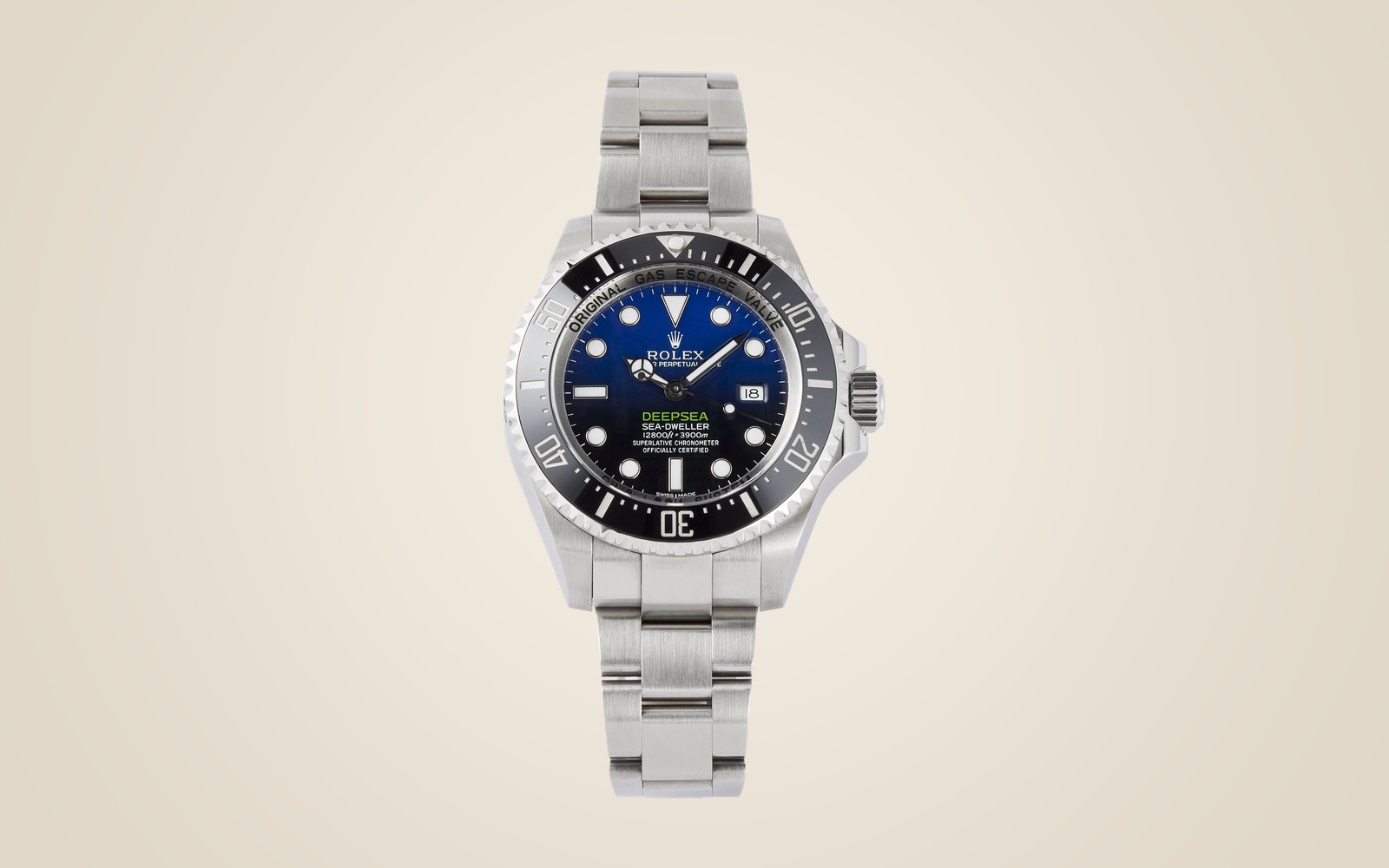
The D-blue dial – In August 2014, Rolex marked Cameron's dive with the Rolex Sea-Dweller Deepsea "D-Blue", whose dial fades from deep blue at the top to black at the bottom, like water getting darker as you go down. The word DEEPSEA is printed in the green of Cameron's submarine. "D-blue" is Rolex's own name for the dial; collectors call this one the "James Cameron."
The case – The production Deepsea is rated to 3,900 m (390 bar), with a three-part case Rolex calls Ringlock: a thick domed crystal, a ring of nitrogen-alloyed steel inside the case, and a titanium back. The deeper it goes, the harder the water presses the back against that ring, which tightens the seal. The top of that ring is the raised, engraved band you can see around the dial.
The first D-Blue – At 44 mm wide and 17.7 mm thick, it sits tall on the wrist. This original version ran until 2018, when Rolex kept the blue-to-black look but gave its successor a new case, a wider bracelet, and a newer movement. That makes the 2014 watch the only D-Blue that runs for about two days off the wrist instead of three.
Specs
Case: 44 mm × 17.7 mm, Oystersteel with titanium caseback
Movement: Cal. 3135, automatic, 48 h
Signature: blue-to-black gradient dial with green DEEPSEA lettering
Reference: 116660-0003
Year: 2014–2018 (discontinued)
Approx. price: US$ 13,100
James Cameron's 2012 dive, told through the color of the dial
The dive – In March 2012, James Cameron piloted his one-man submarine 10,908 m down to the bottom of the Mariana Trench, with an experimental Rolex rated to 12,000 m mounted on the outside. It was the second time a Rolex had made that trip. In January 1960, a Rolex Deep Sea Special rode on the hull of the bathyscaphe Trieste when Jacques Piccard and Don Walsh reached the bottom of the same trench.
The D-blue dial – In August 2014, Rolex marked Cameron's dive with the Rolex Sea-Dweller Deepsea "D-Blue", whose dial fades from deep blue at the top to black at the bottom, like water getting darker as you go down. The word DEEPSEA is printed in the green of Cameron's submarine. "D-blue" is Rolex's own name for the dial; collectors call this one the "James Cameron."
The case – The production Deepsea is rated to 3,900 m (390 bar), with a three-part case Rolex calls Ringlock: a thick domed crystal, a ring of nitrogen-alloyed steel inside the case, and a titanium back. The deeper it goes, the harder the water presses the back against that ring, which tightens the seal. The top of that ring is the raised, engraved band you can see around the dial.
The first D-Blue – At 44 mm wide and 17.7 mm thick, it sits tall on the wrist. This original version ran until 2018, when Rolex kept the blue-to-black look but gave its successor a new case, a wider bracelet, and a newer movement. That makes the 2014 watch the only D-Blue that runs for about two days off the wrist instead of three.
Specs
Case: 44 mm × 17.7 mm, Oystersteel with titanium caseback
Movement: Cal. 3135, automatic, 48 h
Signature: blue-to-black gradient dial with green DEEPSEA lettering
Reference: 116660-0003
Year: 2014–2018 (discontinued)
Approx. price: US$ 13,100
2. Rolex Submariner Date "Starbucks"
Green bezel, black dial, and still in production
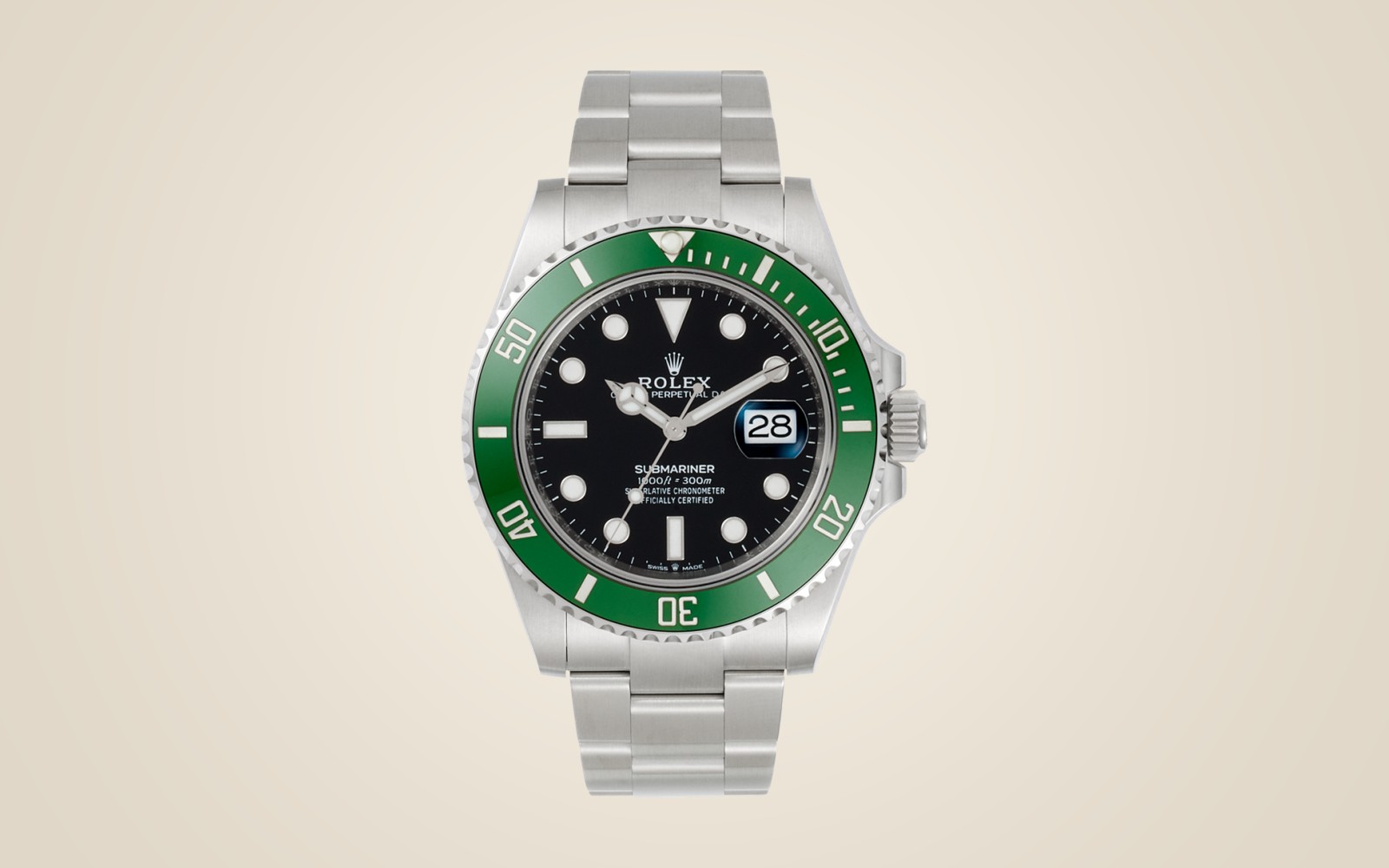
The green line – The 2003 Kermit paired a green aluminum bezel with a black dial. Its 2010 successor went green on the dial as well, and collectors called it the "Hulk," for the color and for its chunkier lugs. When the Rolex Submariner Date "Starbucks" arrived in September 2020, it went back to a black dial under a green ceramic bezel, and the pairing reminded some people of the coffee chain's logo.
The name – At launch, watch writers tried "Kermit II," "Bullitt," and "Cermit" before Starbucks stuck, and some sellers still list this watch as a "Kermit," a name that belongs to the 2003 original. The LV in the reference stands for lunette verte, French for green bezel.
The 2020 case – The current case is 41 mm wide, with a bracelet 21 mm across at the lugs, and straps cut for older 40 mm Submariners won't fit it. It's water resistant to 300 m (30 bar), and the clasp extends by up to 20 mm in small steps, without tools, for a wetsuit or a hot day.
The 2023 green – In 2023, without announcing it, Rolex switched to a brighter, more saturated green insert. Collectors call the darker original MK1 and the brighter one MK2, and because both carry the same reference, only the shade tells them apart.
Specs
Case: 41 mm, Oystersteel
Movement: Cal. 3235, automatic, 70 h
Signature: green ceramic bezel on a black dial
Reference: 126610LV-0002
Year: 2020–present
Approx. price: US$ 14,000
Green bezel, black dial, and still in production
The green line – The 2003 Kermit paired a green aluminum bezel with a black dial. Its 2010 successor went green on the dial as well, and collectors called it the "Hulk," for the color and for its chunkier lugs. When the Rolex Submariner Date "Starbucks" arrived in September 2020, it went back to a black dial under a green ceramic bezel, and the pairing reminded some people of the coffee chain's logo.
The name – At launch, watch writers tried "Kermit II," "Bullitt," and "Cermit" before Starbucks stuck, and some sellers still list this watch as a "Kermit," a name that belongs to the 2003 original. The LV in the reference stands for lunette verte, French for green bezel.
The 2020 case – The current case is 41 mm wide, with a bracelet 21 mm across at the lugs, and straps cut for older 40 mm Submariners won't fit it. It's water resistant to 300 m (30 bar), and the clasp extends by up to 20 mm in small steps, without tools, for a wetsuit or a hot day.
The 2023 green – In 2023, without announcing it, Rolex switched to a brighter, more saturated green insert. Collectors call the darker original MK1 and the brighter one MK2, and because both carry the same reference, only the shade tells them apart.
Specs
Case: 41 mm, Oystersteel
Movement: Cal. 3235, automatic, 70 h
Signature: green ceramic bezel on a black dial
Reference: 126610LV-0002
Year: 2020–present
Approx. price: US$ 14,000
3. Rolex Datejust 36 "Wimbledon"
A tennis nickname on the Datejust's original 36 mm
The original 36 mm – The first Datejust of 1945 measured 36 mm. This one takes a dial that began on the larger, 41 mm Datejust II and brings it back to the size the model was born in.
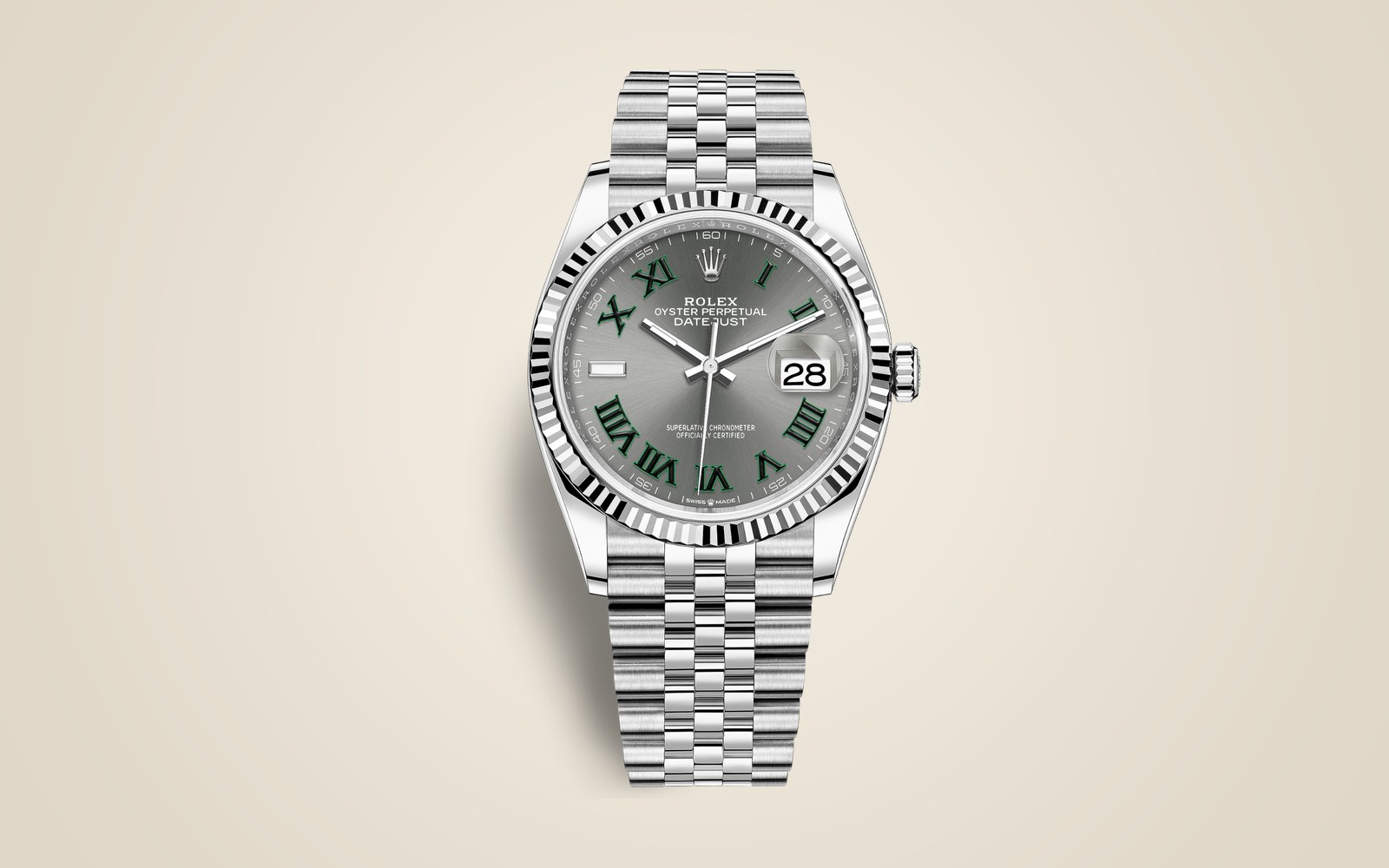
The green numerals – The numerals are black, outlined in green, on a sunray gray base, and the four is written IIII. They don't glow in the dark: apart from the hands, the only luminous marker is the small baton at 9 o'clock. Rolex calls it a slate dial with green Roman numerals, and collectors named it after Wimbledon, the tennis tournament Rolex times, though nobody knows who said it first.
The white gold bezel – Rolex slimmed the Datejust 36 in 2018 and added this steel version in 2019, with a fluted bezel, the ridged ring around the crystal, in white gold. On the Rolex Datejust 36 "Wimbledon" on a Jubilee bracelet, that bezel is the only gold on the watch. The same dial also comes with a smooth steel bezel and in two-tone versions, so check the bezel before comparing listings.
Specs
Case: 36 mm, Oystersteel with 18k white gold fluted bezel
Movement: Cal. 3235, automatic, 70 h
Signature: slate dial with green-outlined Roman numerals
Reference: 126234-0045
Year: c. 2021–present
Approx. price: US$ 14,700
A tennis nickname on the Datejust's original 36 mm
The original 36 mm – The first Datejust of 1945 measured 36 mm. This one takes a dial that began on the larger, 41 mm Datejust II and brings it back to the size the model was born in.
The green numerals – The numerals are black, outlined in green, on a sunray gray base, and the four is written IIII. They don't glow in the dark: apart from the hands, the only luminous marker is the small baton at 9 o'clock. Rolex calls it a slate dial with green Roman numerals, and collectors named it after Wimbledon, the tennis tournament Rolex times, though nobody knows who said it first.
The white gold bezel – Rolex slimmed the Datejust 36 in 2018 and added this steel version in 2019, with a fluted bezel, the ridged ring around the crystal, in white gold. On the Rolex Datejust 36 "Wimbledon" on a Jubilee bracelet, that bezel is the only gold on the watch. The same dial also comes with a smooth steel bezel and in two-tone versions, so check the bezel before comparing listings.
Specs
Case: 36 mm, Oystersteel with 18k white gold fluted bezel
Movement: Cal. 3235, automatic, 70 h
Signature: slate dial with green-outlined Roman numerals
Reference: 126234-0045
Year: c. 2021–present
Approx. price: US$ 14,700
4. Rolex GMT-Master II "Sprite"
Rolex's first modern regular-production watch with its crown on the left
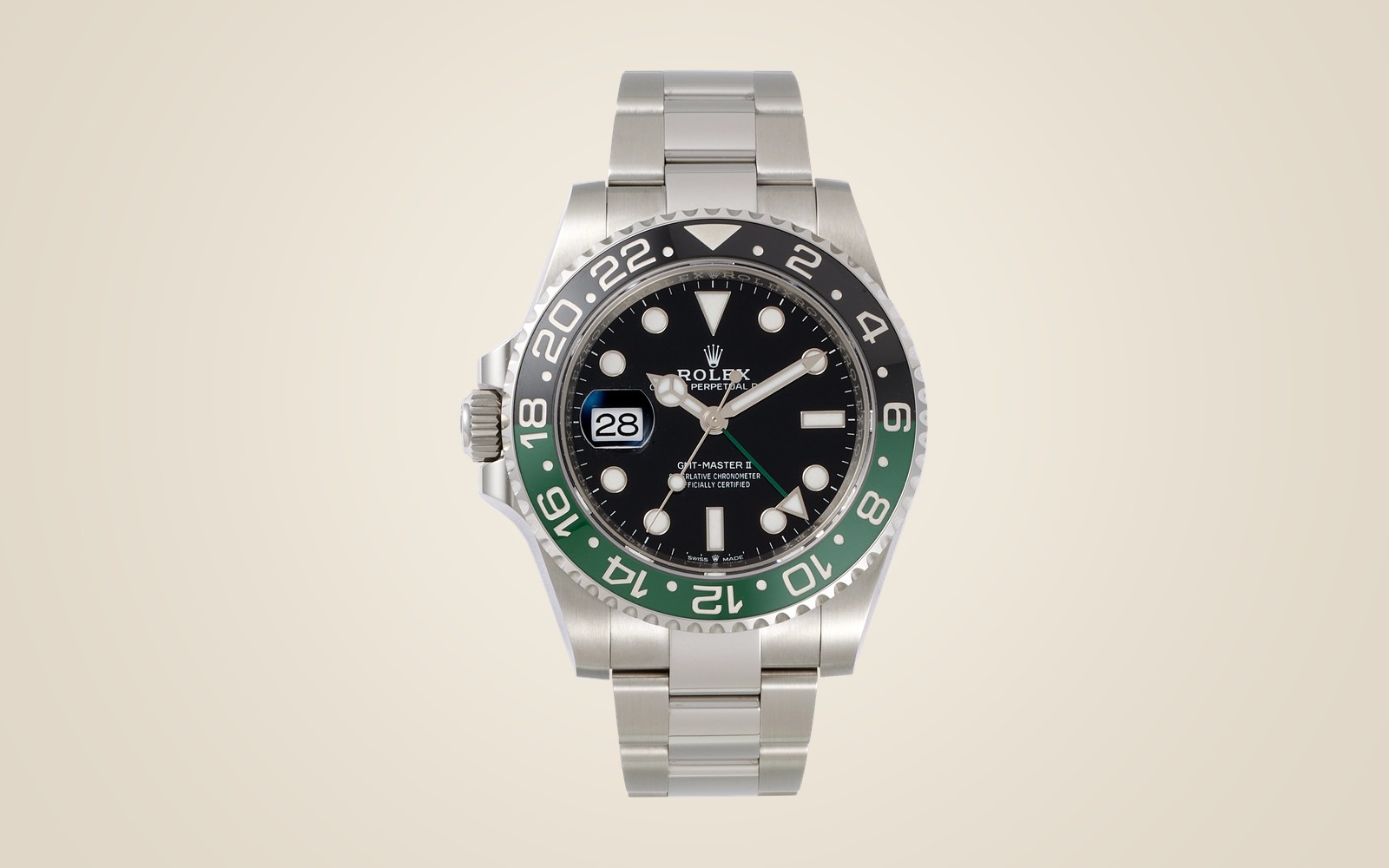
The left-hand crown – At Watches and Wonders in March 2022, Rolex launched a left-handed Rolex GMT-Master II with the crown and the date window moved to the left side of the case. No modern regular-production Rolex had been built that way before, though its sister brand Tudor already made a left-handed dive watch. Collectors call the layout "destro," slang for a watch worn on the right wrist, usually by left-handed people, and Rolex never said who it was for.
The same watch, turned around – The change didn't need a new case or a new movement. Rolex kept caliber 3285 from its other GMT-Masters and repositioned the dial and bracelet around it. The Sprite works exactly like them, with a green 24-hour hand and a turning bezel that track a second time zone. According to Rolex, the small premium over the right-handed models paid for new testing equipment.
The green-and-black insert – The insert starts as one piece of green ceramic, and half of it is then turned black, a pairing Rolex had never used on a bezel before. Collectors named it after the green of a lemon-lime soda. In 2025, Rolex added a left-handed version in solid white gold with a green dial, and in 2026 the steel Sprite stayed in the catalog when the Pepsi left it.
Specs
Case: 40 mm, Oystersteel
Movement: Cal. 3285, automatic, GMT, 70 h
Signature: crown and date window on the left side of the case
Reference: 126720VTNR-0001
Year: 2022–present
Approx. price: US$ 16,500
Rolex's first modern regular-production watch with its crown on the left
The left-hand crown – At Watches and Wonders in March 2022, Rolex launched a left-handed Rolex GMT-Master II with the crown and the date window moved to the left side of the case. No modern regular-production Rolex had been built that way before, though its sister brand Tudor already made a left-handed dive watch. Collectors call the layout "destro," slang for a watch worn on the right wrist, usually by left-handed people, and Rolex never said who it was for.
The same watch, turned around – The change didn't need a new case or a new movement. Rolex kept caliber 3285 from its other GMT-Masters and repositioned the dial and bracelet around it. The Sprite works exactly like them, with a green 24-hour hand and a turning bezel that track a second time zone. According to Rolex, the small premium over the right-handed models paid for new testing equipment.
The green-and-black insert – The insert starts as one piece of green ceramic, and half of it is then turned black, a pairing Rolex had never used on a bezel before. Collectors named it after the green of a lemon-lime soda. In 2025, Rolex added a left-handed version in solid white gold with a green dial, and in 2026 the steel Sprite stayed in the catalog when the Pepsi left it.
Specs
Case: 40 mm, Oystersteel
Movement: Cal. 3285, automatic, GMT, 70 h
Signature: crown and date window on the left side of the case
Reference: 126720VTNR-0001
Year: 2022–present
Approx. price: US$ 16,500
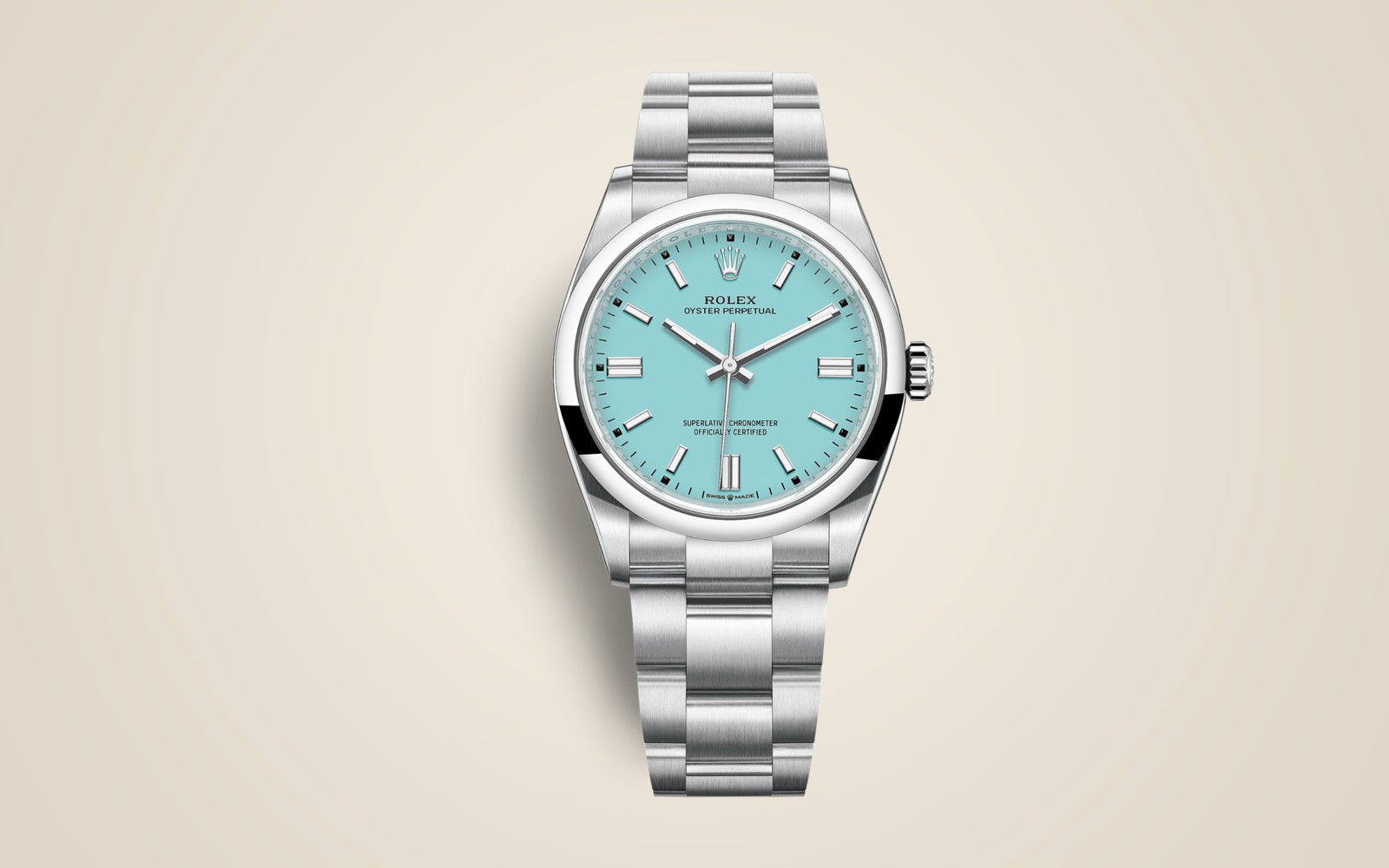
5. Rolex Oyster Perpetual 36 Turquoise
Turquoise lacquer that outlasted the 41 mm version
The 2020 relaunch – The turquoise was one of five glossy lacquer colors Rolex gave the Oyster Perpetual in September 2020, when it also redrew the dial with a plain minute track and hands and markers that glow blue. The 41 mm turquoise and the turquoise-based "Celebration" dial have since left the catalog, but the 36 mm was still reaching buyers with warranty cards dated July 2026.
The "Tiffany" name – Collectors call it the "Tiffany," after the jeweler's blue, but the Rolex Oyster Perpetual 36 in turquoise carries no Tiffany & Co. signature. Rolex did sell watches with Tiffany-signed dials through a retail relationship that ended in the early 1990s, and those are vintage pieces. Repainted turquoise dials turn up on the market too.
Specs
Case: 36 mm × 11.6 mm, Oystersteel
Movement: Cal. 3230, automatic, 70 h
Signature: glossy turquoise lacquer dial
Reference: 126000-0006
Year: 2020–present
Approx. price: US$ 17,300
Turquoise lacquer that outlasted the 41 mm version
The 2020 relaunch – The turquoise was one of five glossy lacquer colors Rolex gave the Oyster Perpetual in September 2020, when it also redrew the dial with a plain minute track and hands and markers that glow blue. The 41 mm turquoise and the turquoise-based "Celebration" dial have since left the catalog, but the 36 mm was still reaching buyers with warranty cards dated July 2026.
The "Tiffany" name – Collectors call it the "Tiffany," after the jeweler's blue, but the Rolex Oyster Perpetual 36 in turquoise carries no Tiffany & Co. signature. Rolex did sell watches with Tiffany-signed dials through a retail relationship that ended in the early 1990s, and those are vintage pieces. Repainted turquoise dials turn up on the market too.
Specs
Case: 36 mm × 11.6 mm, Oystersteel
Movement: Cal. 3230, automatic, 70 h
Signature: glossy turquoise lacquer dial
Reference: 126000-0006
Year: 2020–present
Approx. price: US$ 17,300
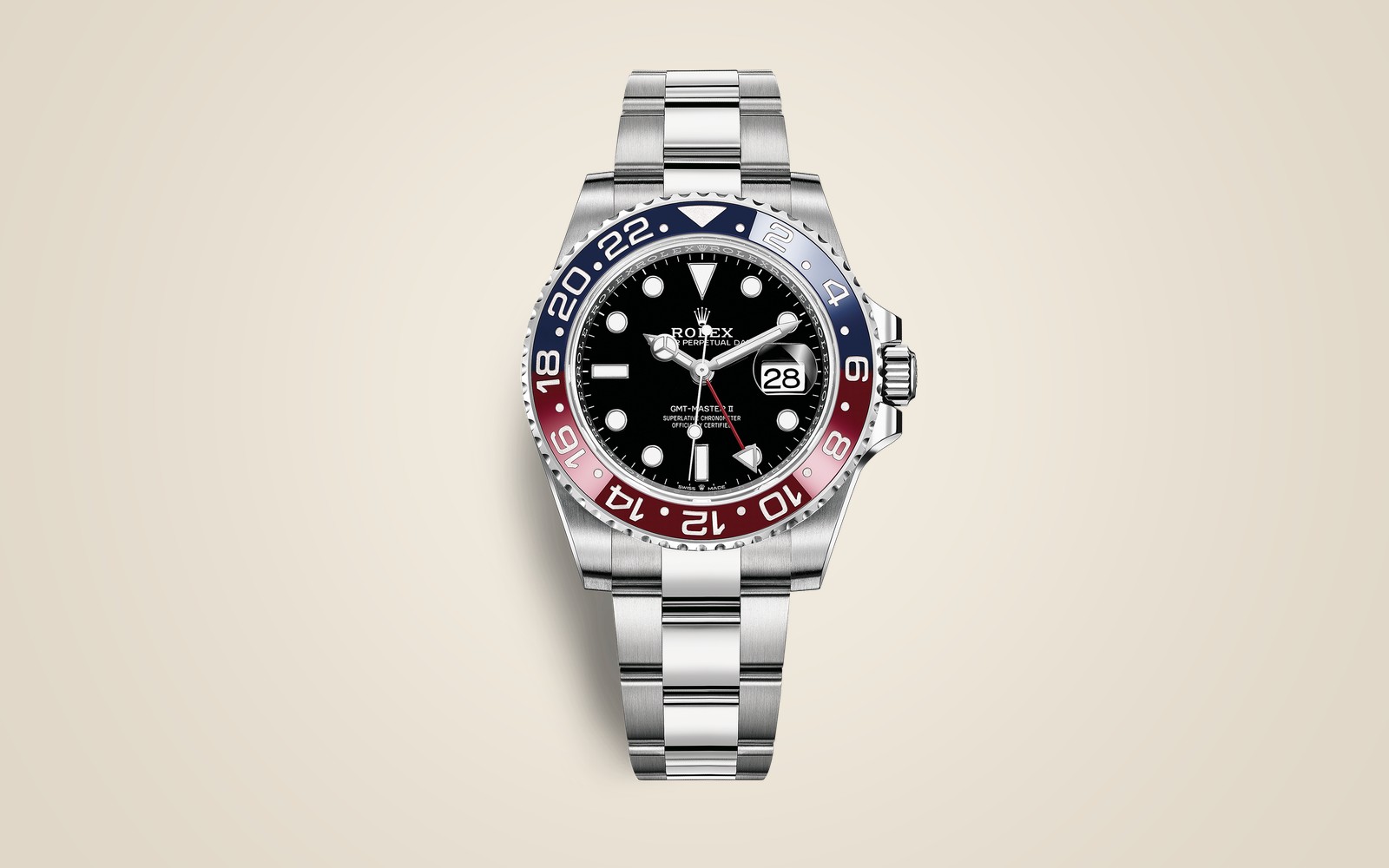
6. Rolex GMT-Master II "Pepsi"
The last steel Rolex with red in its bezel
The 2026 exit – Word that Rolex had stopped delivering the steel Pepsi to its dealers spread in February 2026. Rolex then removed the watch from its website on the opening day of Watches and Wonders that April, without an announcement.
The 11-year gap – Rolex has stopped making the steel Pepsi before. The aluminum-bezel 16710 ended in 2007, when the GMT-Master II moved to ceramic bezels, and Rolex didn't make a ceramic insert in two colors until 2013, on the blue-and-black "Batman," which is still in production. A steel Pepsi didn't return until 2018.
The Oyster bracelet – That 2018 return came only on the five-piece Jubilee bracelet. The Rolex GMT-Master II "Pepsi" on the Oyster bracelet, ref. 126710BLRO-0002, followed in April 2021 with the three-piece links of Rolex's tool watches, and it ran for five years before the 2026 exit.
The bezel numerals – The numbers on the bezel are molded into the ceramic, then coated and polished back. The old aluminum inserts were softer and their colors faded in sunlight, which is why vintage Pepsi bezels so often show wear. Ceramic is virtually scratchproof, and its red and blue don't fade.
Specs
Case: 40 mm, Oystersteel
Movement: Cal. 3285, automatic, GMT, 70 h
Signature: one-piece red-and-blue ceramic 24-hour bezel on a three-link Oyster bracelet
Reference: 126710BLRO-0002
Year: 2021–2026 (discontinued)
Approx. price: US$ 25,600
The last steel Rolex with red in its bezel
The 2026 exit – Word that Rolex had stopped delivering the steel Pepsi to its dealers spread in February 2026. Rolex then removed the watch from its website on the opening day of Watches and Wonders that April, without an announcement.
The 11-year gap – Rolex has stopped making the steel Pepsi before. The aluminum-bezel 16710 ended in 2007, when the GMT-Master II moved to ceramic bezels, and Rolex didn't make a ceramic insert in two colors until 2013, on the blue-and-black "Batman," which is still in production. A steel Pepsi didn't return until 2018.
The Oyster bracelet – That 2018 return came only on the five-piece Jubilee bracelet. The Rolex GMT-Master II "Pepsi" on the Oyster bracelet, ref. 126710BLRO-0002, followed in April 2021 with the three-piece links of Rolex's tool watches, and it ran for five years before the 2026 exit.
The bezel numerals – The numbers on the bezel are molded into the ceramic, then coated and polished back. The old aluminum inserts were softer and their colors faded in sunlight, which is why vintage Pepsi bezels so often show wear. Ceramic is virtually scratchproof, and its red and blue don't fade.
Specs
Case: 40 mm, Oystersteel
Movement: Cal. 3285, automatic, GMT, 70 h
Signature: one-piece red-and-blue ceramic 24-hour bezel on a three-link Oyster bracelet
Reference: 126710BLRO-0002
Year: 2021–2026 (discontinued)
Approx. price: US$ 25,600
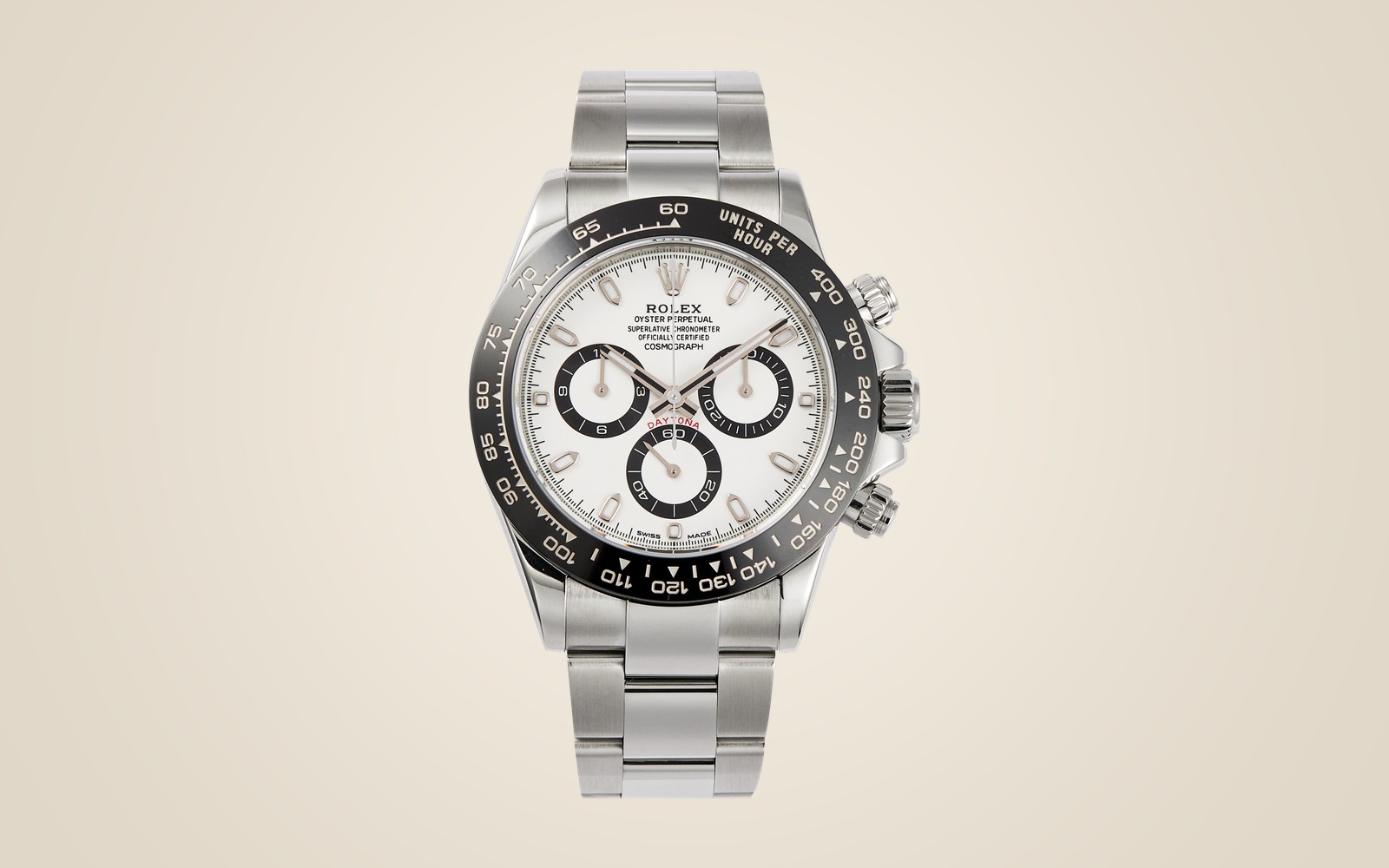
7. Rolex Cosmograph Daytona "Panda" 116500LN
The steel Daytona that brought back the black bezel
The black bezel – Steel Daytonas went 28 years without a black bezel. The original of 1963 had its speed scale engraved on steel, Rolex added a black acrylic insert as an option in 1965, and from 1988 every Daytona bezel was metal. When this reference arrived at Baselworld in March 2016, it brought the black back in ceramic, the first ceramic bezel on a steel Daytona.
The Panda dial – A white dial with three black sub-dials is the look of the 1970s Daytona ref. 6263, which also wore a black bezel. The Rolex Daytona 116500LN with the white dial puts that pairing back together in a modern 40 mm case, with chronograph buttons that screw down for a water resistance of 100 m (10 bar).
The tachymeter scale – A tachymeter measures speed. Start the chronograph as you pass one roadside marker, stop it at the next one a kilometer on, and the number the seconds hand points to on the bezel is your average speed in kilometers per hour. Here the numbers are molded into the ceramic, coated with platinum, and set to follow the curve of the bezel, in a typeface Rolex had used before only on gold and platinum Daytonas. This reference ran until March 2023, when the current 126500LN replaced it.
Specs
Case: 40 mm × 12.2 mm, Oystersteel
Movement: Cal. 4130, automatic chronograph, 72 h
Signature: curved, platinum-coated tachymeter numerals in a black ceramic bezel
Reference: 116500LN-0001
Year: 2016–2023 (discontinued)
Approx. price: US$ 33,900
The steel Daytona that brought back the black bezel
The black bezel – Steel Daytonas went 28 years without a black bezel. The original of 1963 had its speed scale engraved on steel, Rolex added a black acrylic insert as an option in 1965, and from 1988 every Daytona bezel was metal. When this reference arrived at Baselworld in March 2016, it brought the black back in ceramic, the first ceramic bezel on a steel Daytona.
The Panda dial – A white dial with three black sub-dials is the look of the 1970s Daytona ref. 6263, which also wore a black bezel. The Rolex Daytona 116500LN with the white dial puts that pairing back together in a modern 40 mm case, with chronograph buttons that screw down for a water resistance of 100 m (10 bar).
The tachymeter scale – A tachymeter measures speed. Start the chronograph as you pass one roadside marker, stop it at the next one a kilometer on, and the number the seconds hand points to on the bezel is your average speed in kilometers per hour. Here the numbers are molded into the ceramic, coated with platinum, and set to follow the curve of the bezel, in a typeface Rolex had used before only on gold and platinum Daytonas. This reference ran until March 2023, when the current 126500LN replaced it.
Specs
Case: 40 mm × 12.2 mm, Oystersteel
Movement: Cal. 4130, automatic chronograph, 72 h
Signature: curved, platinum-coated tachymeter numerals in a black ceramic bezel
Reference: 116500LN-0001
Year: 2016–2023 (discontinued)
Approx. price: US$ 33,900
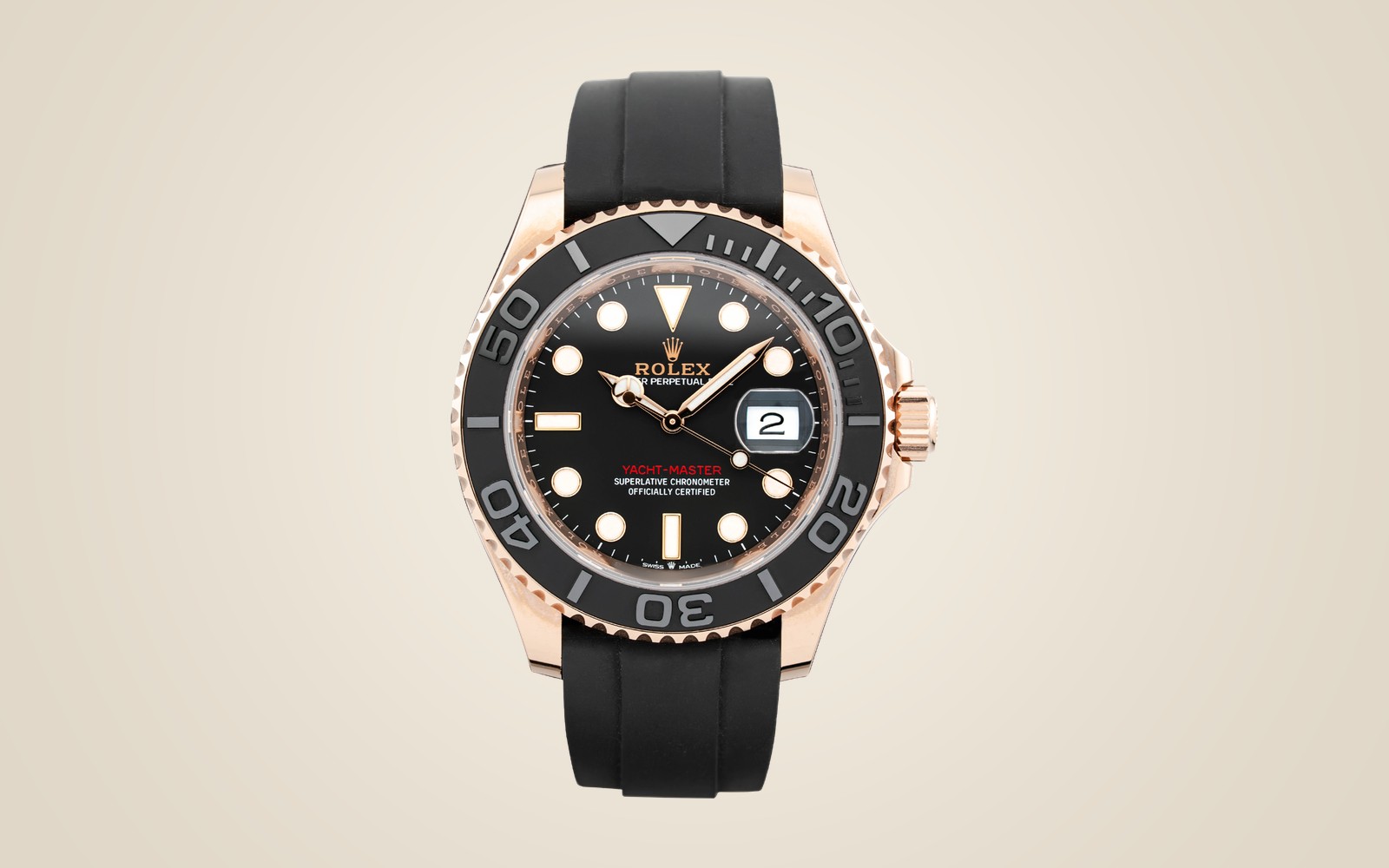
8. Rolex Yacht-Master 40 Everose Oysterflex
Where the Oysterflex started
The Oysterflex – The Oysterflex strap made its debut on the Everose Yacht-Master at Baselworld in March 2015, and two years later the Daytona got it too. Rolex says it is about as strong as a metal bracelet, and at launch the way it joined the case was unique to this model. The Yacht-Master 40 in Everose gold here is the 2019 update, which kept the strap and moved to Rolex's newer caliber 3235.
The cushions – On the underside, a patented set of lengthwise cushions holds the watch steady and stops it rolling around the wrist.
The matte ceramic bezel – The black ceramic bezel is finished the opposite way to Rolex's other ceramic bezels: instead of numbers engraved into a glossy surface, it has raised, polished numbers standing up from a matte, sandblasted one.
Specs
Case: 40 mm, 18k Everose gold
Movement: Cal. 3235, automatic, 70 h
Signature: matte black ceramic bezel with raised, polished numerals
Reference: 126655-0002
Year: 2019–present
Approx. price: US$ 34,700
Where the Oysterflex started
The Oysterflex – The Oysterflex strap made its debut on the Everose Yacht-Master at Baselworld in March 2015, and two years later the Daytona got it too. Rolex says it is about as strong as a metal bracelet, and at launch the way it joined the case was unique to this model. The Yacht-Master 40 in Everose gold here is the 2019 update, which kept the strap and moved to Rolex's newer caliber 3235.
The cushions – On the underside, a patented set of lengthwise cushions holds the watch steady and stops it rolling around the wrist.
The matte ceramic bezel – The black ceramic bezel is finished the opposite way to Rolex's other ceramic bezels: instead of numbers engraved into a glossy surface, it has raised, polished numbers standing up from a matte, sandblasted one.
Specs
Case: 40 mm, 18k Everose gold
Movement: Cal. 3235, automatic, 70 h
Signature: matte black ceramic bezel with raised, polished numerals
Reference: 126655-0002
Year: 2019–present
Approx. price: US$ 34,700
9. Rolex Day-Date 40 "Olive"
An anniversary dial Rolex never retired
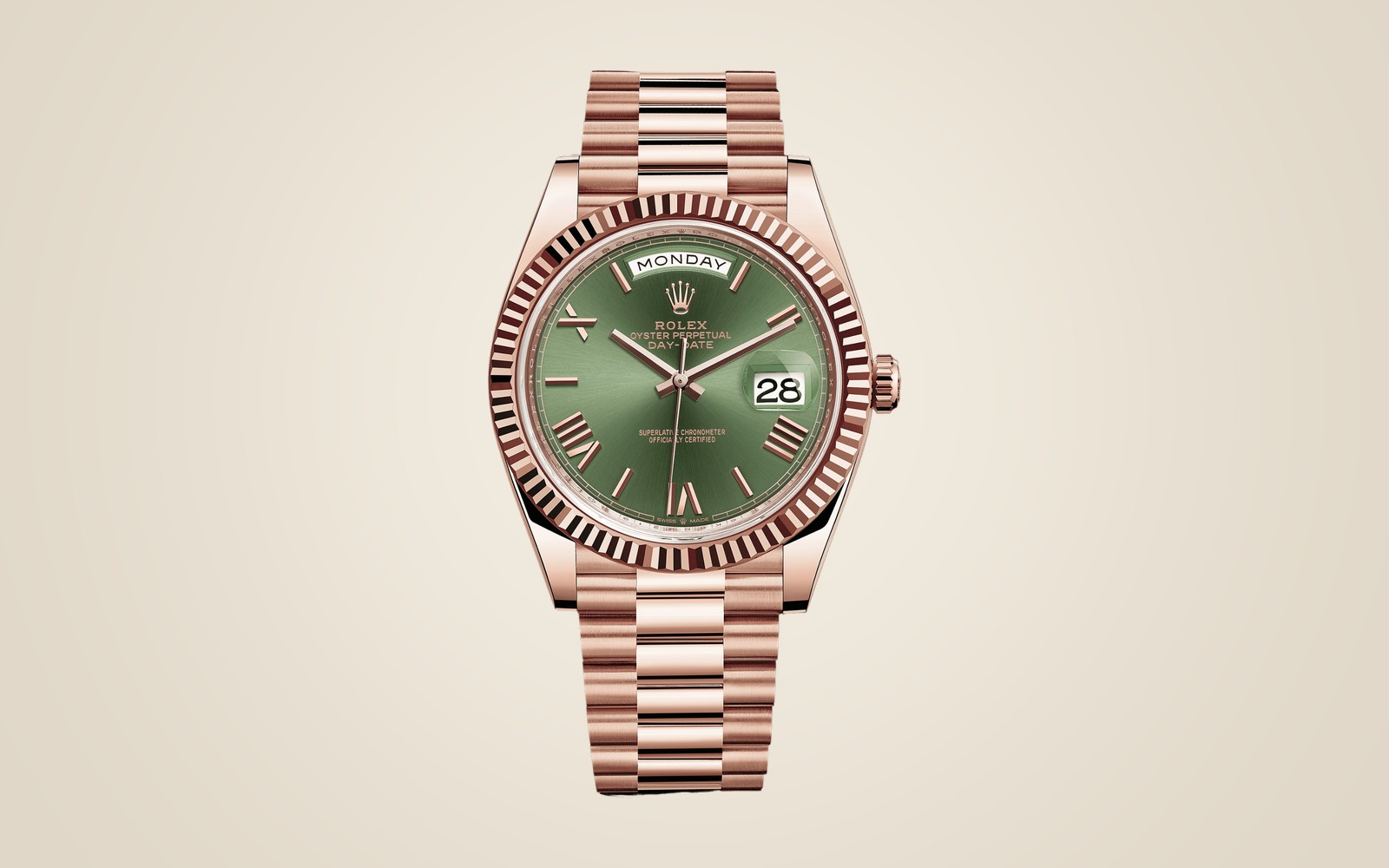
The anniversary dial – Unlike most of the names on this list, "olive" is Rolex's own. Rolex introduced the olive green dial at Baselworld in March 2016 for the Day-Date's 60th anniversary, in Everose and white gold. Polished Everose Roman numerals replace the usual hour markers, and reviewers have described the sunray green as everything from bright olive to dark moss.
The new gold – Everose, the pink gold Rolex has cast in its own foundry since 2005, was its newest gold alloy for more than 20 years. In April 2026, Rolex introduced Jubilee Gold, a paler gold that sits between yellow and rose, on a Day-Date 40 with a dial cut from green aventurine stone and diamond hour markers. Its reference, 228235JG, shares this watch's 228235 base number.
The hidden clasp – The President bracelet tapers from 20 mm at the case to 16 mm at the clasp, which is hidden and opens when you lift the small gold Rolex crown at its center. Rolex also offers the day in 26 languages, so a pre-owned Day-Date 40 in Everose with the olive dial may show it in a language other than English.
Specs
Case: 40 mm × 12 mm, 18k Everose gold
Movement: Cal. 3255, automatic, day-date, 70 h
Signature: olive green sunray dial with Everose Roman numerals
Reference: 228235-0025
Year: 2016–present
Approx. price: US$ 64,400
An anniversary dial Rolex never retired
The anniversary dial – Unlike most of the names on this list, "olive" is Rolex's own. Rolex introduced the olive green dial at Baselworld in March 2016 for the Day-Date's 60th anniversary, in Everose and white gold. Polished Everose Roman numerals replace the usual hour markers, and reviewers have described the sunray green as everything from bright olive to dark moss.
The new gold – Everose, the pink gold Rolex has cast in its own foundry since 2005, was its newest gold alloy for more than 20 years. In April 2026, Rolex introduced Jubilee Gold, a paler gold that sits between yellow and rose, on a Day-Date 40 with a dial cut from green aventurine stone and diamond hour markers. Its reference, 228235JG, shares this watch's 228235 base number.
The hidden clasp – The President bracelet tapers from 20 mm at the case to 16 mm at the clasp, which is hidden and opens when you lift the small gold Rolex crown at its center. Rolex also offers the day in 26 languages, so a pre-owned Day-Date 40 in Everose with the olive dial may show it in a language other than English.
Specs
Case: 40 mm × 12 mm, 18k Everose gold
Movement: Cal. 3255, automatic, day-date, 70 h
Signature: olive green sunray dial with Everose Roman numerals
Reference: 228235-0025
Year: 2016–present
Approx. price: US$ 64,400
10. Rolex Cosmograph Daytona "John Mayer"
The gold Daytona that waited three years for its moment
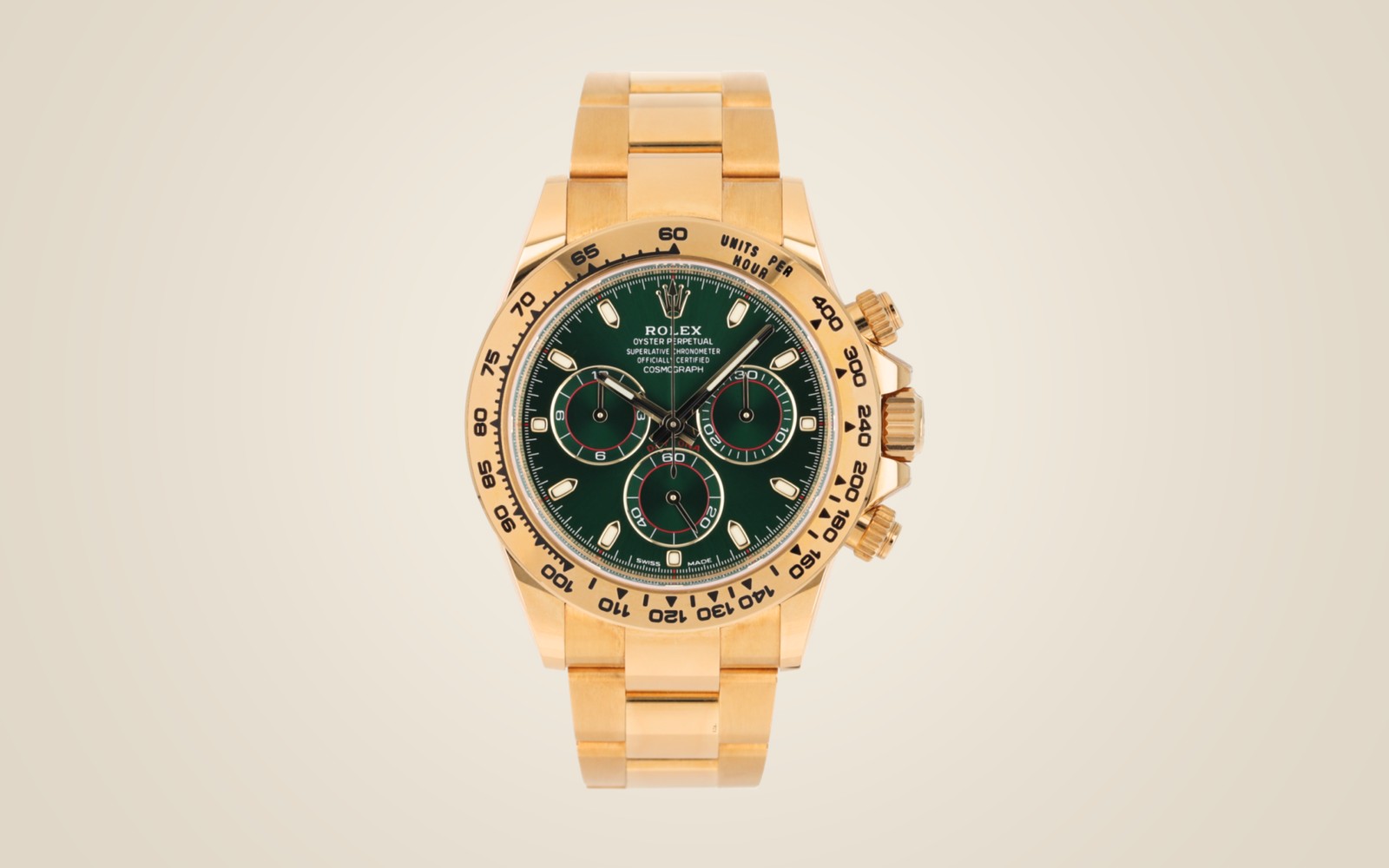
The sleeper – In its first years, the green-dial Daytona in yellow gold could be found sitting in dealers' windows. It had launched at Baselworld in March 2016 alongside the steel Panda above, which took most of the attention. Then, in March 2019, John Mayer called it a "sleeper hit" in his second episode of Hodinkee's Talking Watches, and later that year it sold out at authorized dealers and took his name.
The all-gold build – The yellow gold Rolex Daytona with the green dial is gold throughout, from the case and the engraved tachymeter bezel to the Oyster bracelet, at a time when other Daytonas were moving to ceramic bezels. Its hour markers and hands are gold too, set against a green that one reviewer placed somewhere between pine trees and British racing green.
The successor – Rolex replaced it with the 126508 in March 2023. That reference got a green dial of its own in 2025, and sellers now call both watches the "John Mayer."
Specs
Case: 40 mm × 12.2 mm, 18k yellow gold
Movement: Cal. 4130, automatic chronograph, 72 h
Signature: green sunray dial with 18k gold hour markers
Reference: 116508-0013
Year: 2016–2023 (discontinued)
Approx. price: US$ 76,200
The gold Daytona that waited three years for its moment
The sleeper – In its first years, the green-dial Daytona in yellow gold could be found sitting in dealers' windows. It had launched at Baselworld in March 2016 alongside the steel Panda above, which took most of the attention. Then, in March 2019, John Mayer called it a "sleeper hit" in his second episode of Hodinkee's Talking Watches, and later that year it sold out at authorized dealers and took his name.
The all-gold build – The yellow gold Rolex Daytona with the green dial is gold throughout, from the case and the engraved tachymeter bezel to the Oyster bracelet, at a time when other Daytonas were moving to ceramic bezels. Its hour markers and hands are gold too, set against a green that one reviewer placed somewhere between pine trees and British racing green.
The successor – Rolex replaced it with the 126508 in March 2023. That reference got a green dial of its own in 2025, and sellers now call both watches the "John Mayer."
Specs
Case: 40 mm × 12.2 mm, 18k yellow gold
Movement: Cal. 4130, automatic chronograph, 72 h
Signature: green sunray dial with 18k gold hour markers
Reference: 116508-0013
Year: 2016–2023 (discontinued)
Approx. price: US$ 76,200
Final Thoughts
Our pick is the Submariner "Starbucks." Its name came from buyers reacting to a look, green ceramic on a black dial, rather than a reference number. It is the third green Submariner, after the 2003 Kermit and the 2010 Hulk, and unlike the Pepsi, it is still in production. It is also the nicknamed Rolex we see most: only the plain black Submariner Date has been listed on Wristcheck more often.
Every watch listed on Wristcheck is fully authenticated, transparently priced, and curated with collectors in mind. Whether you're searching for your first Rolex or need a second opinion before making the leap, our team is here to help.
Start browsing, or reach out if you’re ready to lock in the right piece.